

HOA Rules for Impact Windows in Florida: What's Allowed, What's Restricted
Can my HOA or condo association stop me from installing impact windows? Generally, no. Florida law requires condo boards and HOAs to adopt hurricane protection specifications, which can control color, style, and similar factors. But an association can’t deny an installation that conforms to those specifications. The real question is which products and finishes your community allows.
Here’s how the law works, how architectural approval works, and what to check before you sign a contract.
By Dave Meadors
What Florida law says
Two chapters of the Florida Statutes cover this. Chapter 718 governs condominiums. Chapter 720 governs homeowners’ associations (HOAs). Both now contain hurricane-protection rules that point the same way.
Condominiums: §718.113(5)
- The board must adopt specifications. Every residential and mixed-use condominium board must adopt hurricane protection specifications for each building it operates. This applies no matter when the condominium was created. The specifications may cover color, style, and other factors the board considers relevant, and they must comply with the applicable building code.
- A conforming installation can’t be refused. If the condo documents require approval, the board may not refuse to approve a unit owner’s installation or replacement of hurricane protection that conforms to the board’s adopted specifications. The board may require the owner to follow an existing unified building scheme for the building’s external appearance.
- It’s not a “material alteration.” Installing, maintaining, repairing, or replacing hurricane protection under this subsection is not treated as a material alteration or substantial addition to the common elements.
- Removal costs. Unless the declaration says otherwise, if hurricane protection (including exterior windows and doors) has to come out so the association can work on property it is responsible for, the unit owner generally does not pay for the removal or reinstallation.
The term itself is defined in §718.103(19): “hurricane protection” expressly includes impact glass and code-compliant windows and doors, so impact windows fall squarely within the condo rule.
HOAs: §720.3035
- Specifications are required. The HOA board or its architectural committee must adopt hurricane protection specifications for each structure or improvement on a parcel. This applies regardless of when the community was created. The specifications may include color and style and must comply with the applicable building code.
- Impact windows are expressly covered. The statute’s definition of “hurricane protection” includes, but is not limited to, impact-resistant windows and doors, permanent fixed and roll-down storm shutters, polycarbonate panels, reinforced garage doors, and certain roof systems.
- A conforming application can’t be denied. Notwithstanding the association’s governing documents, the board or committee may not deny an application to install, enhance, or replace hurricane protection that conforms to the adopted specifications. As with condos, it may require you to follow an existing unified building scheme for external appearance.
- Denials must be specific. Under §720.3035(4)(a), if the association or committee denies an application, it must give written notice naming the specific rule or covenant it relied on and the specific part of the proposed improvement that doesn’t conform.
- No permit-first requirement. Under §720.3035(1)(c), an HOA may not require you to get a building permit before it will review your plans.
- Owners keep their options. Under §720.3035(2), if the governing documents offer a set of material or design options, the association may not stop you from choosing among them.
General information, not legal advice. Your community’s governing documents and adopted specifications control.
How architectural approval works
Most communities send exterior changes through an architectural review committee or board (often called the ARC or ARB). The details vary, but the process usually looks like this:
- Get the current specifications. Ask the management company or board for the adopted hurricane protection specifications and the application form. Make sure you have the current version, not a copy from a previous owner.
- Choose conforming products. Match the frame color, glass, grille pattern, and window style to what the specifications allow.
- Assemble the packet. A typical packet includes:
- Product approval documents for each product, such as Miami-Dade Notices of Acceptance or Florida Product Approvals (see our NOA explainer for what these documents are and how to read them).
- Manufacturer product literature.
- Color and grille samples or photos.
- A window and door schedule or elevation showing which openings are changing.
- The contractor’s license and certificate of insurance.
- Submit and wait for a written decision. Review timelines are set by each community’s documents and meeting schedule. Some committees meet monthly, so allow time — Florida law sets no response deadline in either Chapter 718 or Chapter 720.
- Permit with the city. The building permit is separate from association approval. Under §720.3035(1)(c), an HOA can’t make a permit a precondition of review, so the two can often move in parallel.
Common causes of denials and delays: incomplete packets, missing or expired product approval documents, an unlisted frame color or tint, grilles that don’t match, and a style change the specifications don’t allow (for example, casement where single-hung is required).
The restriction catalog
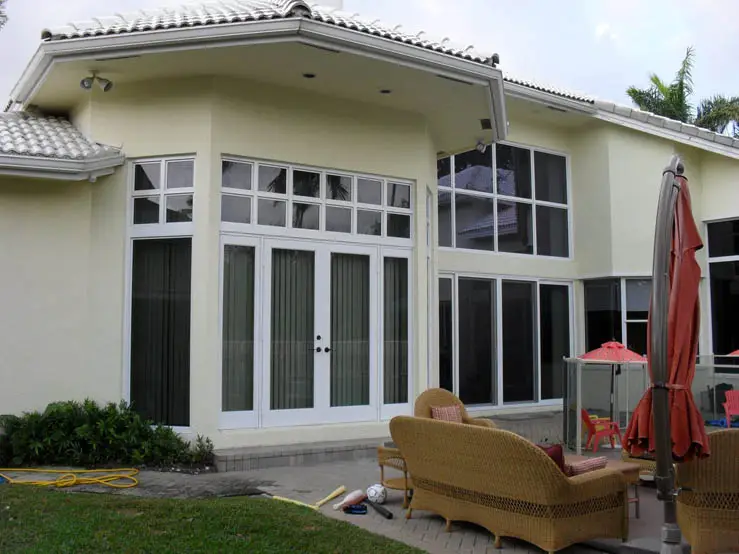
Frame color. White and bronze are the most common standard frame colors and are often what specifications allow. Custom colors may be allowed, limited to a short list, or prohibited. Bring a physical sample or a manufacturer color chip.
Colonial bars and muntin grilles. Specifications differ widely. Some communities require grilles to match the existing windows. Others prohibit them. Many specify the type: grilles-between-the-glass (sealed inside the insulated unit) or simulated divided lites (bars applied to the glass surfaces). If grilles are required, the pattern (how many panes, colonial or prairie) usually has to match too.
Tint and reflective finishes. Communities often limit how dark the tint can be and may prohibit reflective or mirror finishes. Ask whether the specifications name a specific tint or a visible-light percentage, and get a glass sample if you can.
Window style and operation. Specifications may require new windows to keep the existing operation type, such as single-hung, horizontal roller, or casement, so the facade looks consistent from the street.
Sliding doors and balconies in condos. Balcony and terrace sliding doors are often governed by building-wide specifications covering frame color, panel configuration, and sometimes glass. Because the building’s structure and exterior walls are usually association responsibility, check your declaration for who handles what.
Shutters vs. impact glass. Some communities have standardized on one approach, such as a single shutter type, impact glass, or a list of approved options. Your specifications will say which options are available at your building or home.

How Broward Impact works within your community's rules
- We review your community’s adopted hurricane protection specifications before we quote, so the products we propose conform.
- We supply the product approval documents, product literature, and color and grille samples your approval packet needs.
- We match frame color and grille patterns to your community’s requirements.
- We coordinate building permits with the city in parallel with association review.
We sell and install ES Windows and CWS products. Licensed CGC 1514968. Local since 2008, with over 20,000 projects completed.
If your application is denied
- Read the denial against the adopted specifications. Under the statutes, the question is whether your application conformed to the specifications the board adopted, not whether someone preferred a different look.
- For HOAs, look for the required specifics. §720.3035(4)(a) requires written notice naming the rule or covenant relied on and the part of the proposal that doesn’t conform.
- Fix and resubmit. Often the simplest path is to change the nonconforming item (a color, a grille pattern, a tint) and resubmit with conforming products.
- Keep it in writing. Save your application, the specifications version you used, every response, and dates.
- Get advice if it doesn’t resolve. For a dispute that doesn’t resolve, consider talking to a Florida attorney who handles community association law.
Frequently asked questions
Do I need HOA approval to replace my windows with impact windows?
Usually, if your governing documents require approval for exterior changes, and most do. The law limits why a conforming application can be denied. It doesn’t remove the approval step. Check your declaration and specifications.
Can my HOA require colonial bars or grilles?
It can include grille requirements in its adopted specifications as part of style and appearance, or as part of an existing unified building scheme. Some communities require grilles to match existing windows. Others prohibit them.
Can my condo association restrict tint or frame color?
Yes. §718.113(5) lets the board’s specifications include color, style, and other relevant factors, as long as they comply with the building code.
How long does architectural approval take?
It depends on your community’s documents and how often the committee meets, and Florida law sets no deadline for the association to respond. Submitting a complete packet the first time is the most reliable way to avoid delays. Architectural review time is also one of the variables in the overall installation timeline.
What documents does the association need from my installer?
Typically product approval documents (NOA or Florida Product Approval), product literature, color and grille samples or photos, the contractor’s license, and a certificate of insurance. Your community’s form controls.
What if my windows were installed without approval?
Talk to your association and get a copy of the current specifications. If the installed products conform, the board may be able to consider an after-the-fact application. If they don’t, ask what the board requires. Your governing documents control how this is handled, so consider getting legal advice.
Don’t wait for the next hurricane to protect your home. The BEST time is now…
Get Your Free In-Home Estimate
"*" indicates required fields
We’ll review your community’s specifications and help you put together a complete approval packet.
Broward Impact Window & Door · 1954 Tigertail Blvd, Dania Beach, FL 33004 · 954-922-0606 · Hours: Mon–Fri 8:30 AM–6:00 PM, Sat 10:00 AM–2:00 PM, Sun closed.